Loading
projects
Understanding Networks: Email Authentication, Protocol Bridges & Packet Forensics
design-engineeringcreative-coding
- Role
- Network Engineer & Creative Technologist
- Timeline
- Fall 2024
- Technologies
- DNS (SPF / DKIM / DMARC)TCP / UDP SocketsNode.js (net & ws)OSC (Open Sound Control)ARKit & Web Gyroscope APILinux / UFWtcpdump & traceroute
Developed across Tom Igoe's Understanding Networks course at NYU ITP (Fall 2024), this project series investigates how trust, state, and physical interaction move across network layers—from DNS-backed cryptographic email authentication (SPF, DKIM, and DMARC) to real-time UDP/OSC and WebSocket-to-TCP protocol bridges for multiplayer games, autonomous system routing topology, and packet-level firewall and DNS forensics.
1. Email Authentication Architecture: SPF, DKIM & DMARC
Core SMTP (RFC 5321) was designed without built-in sender verification. During an SMTP handshake, a mail transfer agent (MTA) declares two distinct sender identities that recipients rarely see side by side:
- The Envelope Sender (
RFC 5321.MailFrom/Return-Path): Announced during theMAIL FROM:<bounce@server.example.com>SMTP command and used by mail servers for bounce handling. - The Header From (
RFC 5322.From/ "Friendly-From"): Embedded inside the message data payload (From: "Alan" <you@domain.com>) and displayed directly to the human recipient in their mail client.
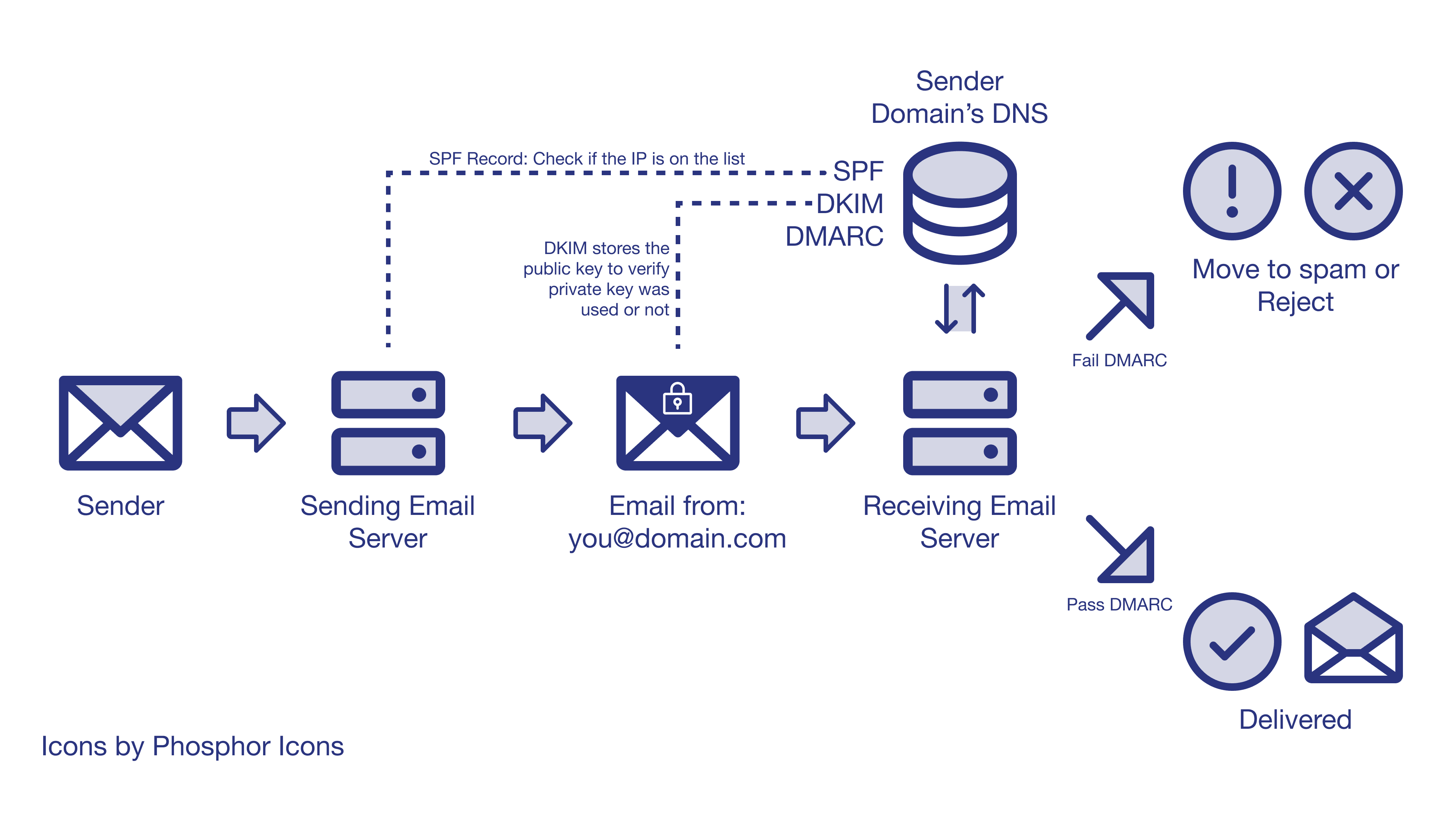
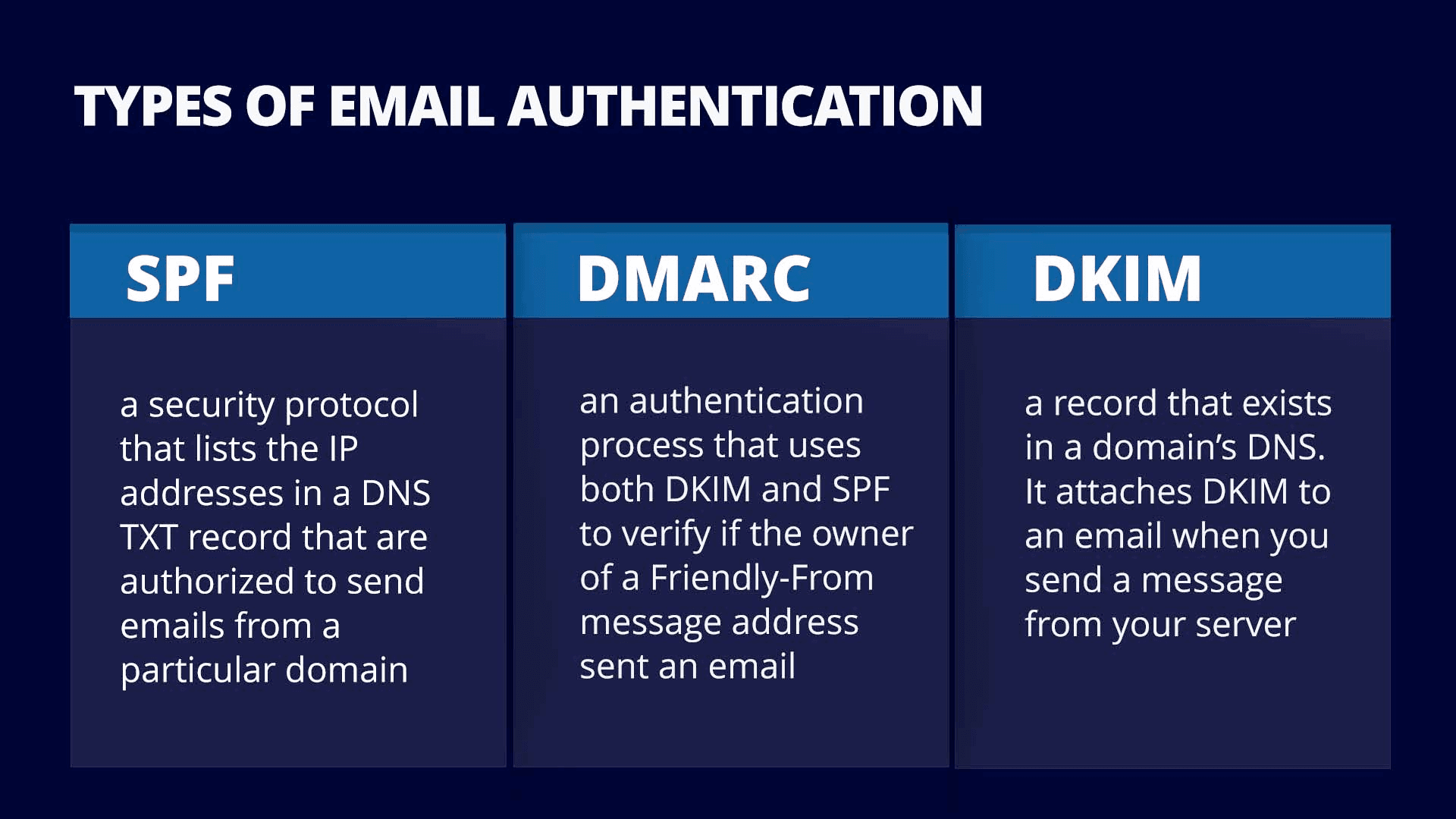
Because raw SMTP allows any host on the internet to open port 25 and supply an arbitrary From: header, modern email security layers three DNS-published mechanisms—SPF, DKIM, and DMARC—to verify where a message originated, prove cryptographic integrity in transit, and enforce domain alignment.
Layer 1: SPF (Sender Policy Framework — RFC 7208)
SPF authenticates the connecting IP address of the sending email server against a list of authorized senders published in the domain's DNS TXT record:
dns
; DNS TXT record at domain.com
domain.com.  3600  IN  TXT  "v=spf1 ip4:198.51.100.24 include:_spf.google.com ~all"
When a receiving MTA accepts a connection from a sending server IP, it extracts the domain from the SMTP MAIL FROM (Return-Path) address, queries that domain's SPF TXT record, and evaluates whether the connecting IP matches an authorized ip4, ip6, a, mx, or include mechanism.
- What SPF solves: Prevents unauthorized servers from sending mail claiming an envelope
Return-Pathon your domain. - Why SPF alone is insufficient:
- The Friendly-From Gap: SPF only validates the hidden
RFC 5321.MailFromenvelope domain—not theRFC 5322.Fromheader shown in the user's inbox. An attacker can pass SPF using their own envelope domain (MAIL FROM:<attacker@evil.example>) while still spoofingFrom: ceo@domain.comin the message body. - Forwarding Fragility: If an intermediary server forwards an email without rewriting the
Return-Path(via SRS), the receiving MTA sees the forwarder's IP instead of the original sender's IP, causing SPF to fail.
- The Friendly-From Gap: SPF only validates the hidden
Layer 2: DKIM (DomainKeys Identified Mail — RFC 6376)
DKIM solves forwarding fragility and in-transit tampering by attaching a cryptographic digital signature directly to the email header.
-
Signing (Outbound MTA): Before transmitting the message, the sending server hashes specified headers (such as
From,To,Subject,Date) and the canonicalized message body, then signs that hash with a private RSA or Ed25519 key. It injects aDKIM-Signatureheader into the email:httpDKIM-Signature: v=1; a=rsa-sha256; c=relaxed/relaxed; d=domain.com; s=2024a; h=from:to:subject:date:message-id; bh=47DEQpj8HBSa+/TImW+5JCeuQeRkm5NMpJWZG3hSuFU=; b=MIIBIjANBgkqhkiG9w0BAQEFAAOCAQ8A... -
Verification (Inbound MTA): The receiving server reads the signing domain (
d=domain.com) and selector (s=2024a), queries the DNSTXTrecord at2024a._domainkey.domain.comto retrieve the public key (p=...), and verifies that the signature matches the message headers and body hash:dns; DNS TXT record at 2024a._domainkey.domain.com 2024a._domainkey.domain.com. 3600 IN TXT "v=DKIM1; k=rsa; p=MIIBIjANBgkqhkiG9w0BAQEFAAOCAQ8AMIIBCgKCAQEA..."
Because the signature travels inside the message header rather than depending on the hop-by-hop connecting IP, a valid DKIM signature survives standard email forwarding as long as intermediate relays do not mutate the signed headers or body.
Layer 3: DMARC (Identifier Alignment & Policy — RFC 7489)
While SPF verifies the connecting IP and DKIM verifies a cryptographic signature, neither protocol by itself requires its authenticated domain to match the RFC 5322.From ("Friendly-From") domain displayed to the end user. DMARC bridges that gap through Identifier Alignment and policy enforcement:
dns
; DNS TXT record at _dmarc.domain.com
_dmarc.domain.com.  3600  IN  TXT  "v=DMARC1; p=quarantine; sp=reject; adkim=s; aspf=r; rua=mailto:dmarc-reports@domain.com"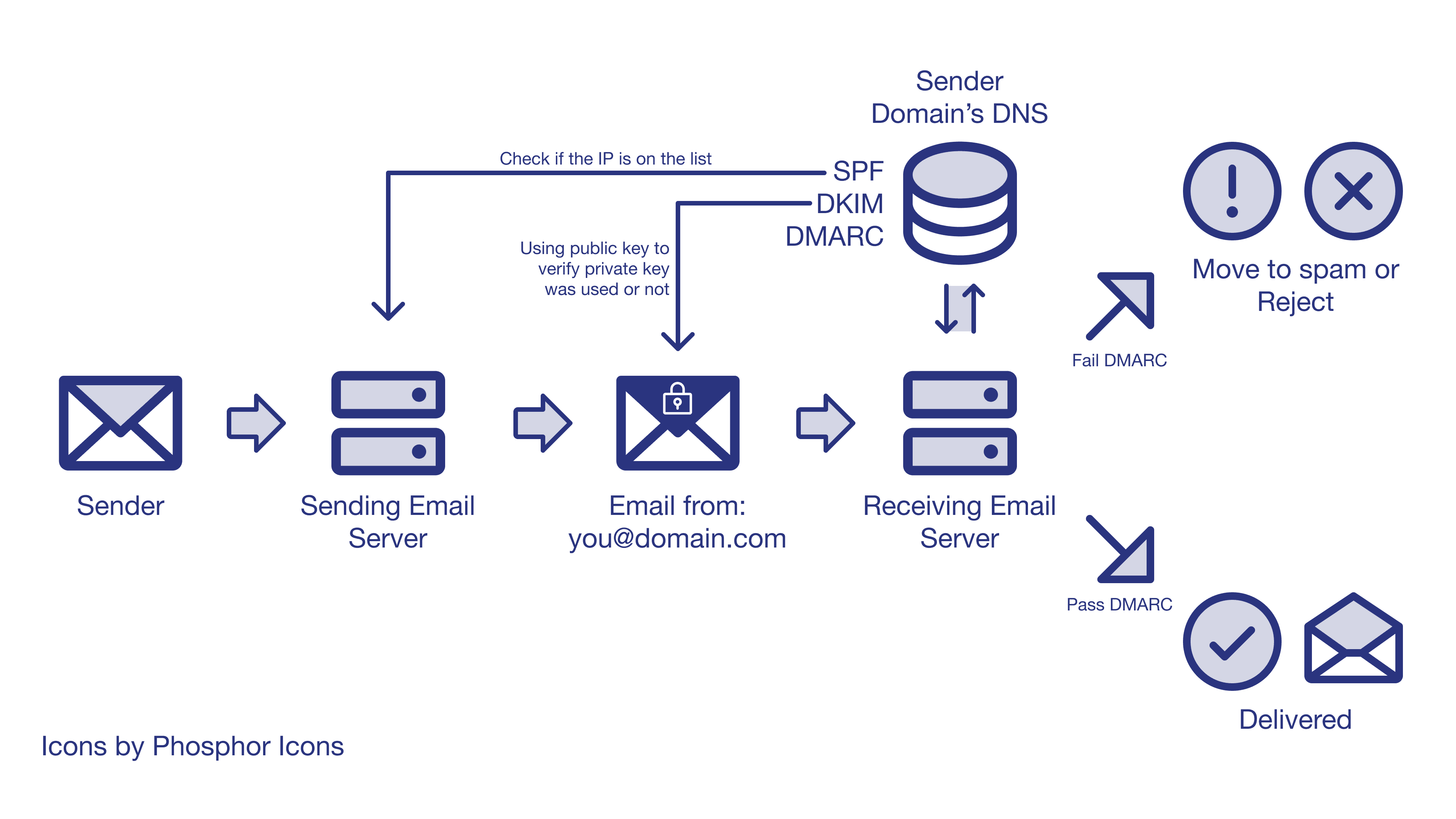
For an email to pass DMARC, at least one of the following alignment checks must succeed:
- SPF Alignment (
aspf): SPF must pass AND the authenticatedRFC 5321.MailFromdomain must match the visibleRFC 5322.Fromdomain (exact match in strict modeaspf=s, or organizational root domain match in relaxed modeaspf=r). - DKIM Alignment (
adkim): DKIM signature verification must pass AND the signing domain (d=) in theDKIM-Signatureheader must match the visibleRFC 5322.Fromdomain.
| Protocol | Authenticated Identity | DNS Record Location | Cryptographic Mechanism | Survives Forwarding? |
|---|---|---|---|---|
| SPF | Connecting MTA IP + RFC 5321.MailFrom (Return-Path) | domain.com (TXT) | None (IP / CIDR / hostname lookup) | No (breaks unless forwarder rewrites envelope via SRS) |
| DKIM | Signing domain (d=) in DKIM-Signature header | <selector>._domainkey.domain.com (TXT) | RSA / Ed25519 asymmetric signature over headers & body hash | Yes (if signed headers and body remain unmodified) |
| DMARC | Visible RFC 5322.From ("Friendly-From") header | _dmarc.domain.com (TXT) | Enforces alignment (aspf / adkim) + disposition (p=none|quarantine|reject) | Yes (via aligned DKIM signature) |
If both SPF alignment and DKIM alignment fail, the receiving server executes the domain owner's published DMARC policy (p=quarantine moves the message to spam; p=reject drops the message at the SMTP gateway) and dispatches aggregate XML telemetry (rua) back to the domain administrator.
2. Real-Time Protocol Bridges for Multiplayer TCP (BallDropServer)
In the second half of the course, we built networked controllers for Tom Igoe's multiplayer Pong-style game BallDropServer. The game server listens on a raw TCP socket (port 8080) and expects newline-terminated ASCII commands (n=Alan\n to set the player name, w/a/s/d to move the paddle, i to toggle IP display, and x to disconnect).
Because neither native mobile sensor apps (which stream Open Sound Control (OSC) datagrams over UDP) nor mobile web browsers (which are sandboxed to HTTP/WebSockets and cannot open raw TCP sockets) can talk to a raw TCP server directly, I engineered two custom Node.js protocol bridges and three physical control modalities.
Modality A: iPhone ARKit Face-Tracking over OSC (UDP $\rightarrow$ TCP)
In the first controller, an iPhone running ARKit TrueDepth face tracking streams real-time facial landmark and head-pose coordinates over campus Wi-Fi via OSC over UDP (port 8000). A local Node.js bridge (OSCServer/server.js) ingests the high-frequency UDP datagrams, thresholds head pitch and yaw into discrete directional states, and writes ASCII paddle commands (w, a, s, d) onto the persistent net.Socket connection to BallDropServer.
Modality B: iOS 6-Axis IMU Motion over OSC (UDP $\rightarrow$ TCP)
Using the same osc.UDPPort to net.Socket bridge architecture, the second iteration listens to raw 6-axis inertial measurement unit (IMU) streams (/data/motion/gyroscope/{x,y,z} and /data/motion/accelerometer/{x,y,z}) transmitted over UDP port 8000 and maps device tilt angles to continuous TCP paddle motion:
javascript
// OSCServer/server.js — Bridging stateless UDP OSC sensor streams to a persistent TCP game socket
const osc = require('osc');
const net = require('net');

const OSC_PORT = 8000;            // Local UDP port receiving iOS OSC sensor packets
const TCP_HOST = '10.18.242.114'; // Classroom BallDropServer IP on NYU LAN
const TCP_PORT = 8080;            // BallDropServer raw TCP port

const udpPort = new osc.UDPPort({
  localAddress: '0.0.0.0',
  localPort: OSC_PORT,
});

udpPort.open();
console.log(`Listening for OSC messages on UDP port ${OSC_PORT}`);

const tcpSocket = new net.Socket();
tcpSocket.connect(TCP_PORT, TCP_HOST, () => {
  console.log(`Connected to TCP server at ${TCP_HOST}:${TCP_PORT}`);
  tcpSocket.write('n=Alan\n');
});

udpPort.on('message', (oscMsg) => {
  const { address, args } = oscMsg;
  const value = args[0];

  if (address === '/data/motion/accelerometer/x') {
    if (value < -0.25) tcpSocket.write('a');
    else if (value > 0.25) tcpSocket.write('d');
  } else if (address === '/data/motion/accelerometer/y') {
    if (value > 0.25) tcpSocket.write('w');
    else if (value < -0.25) tcpSocket.write('s');
  }
});
Modality C: Mobile Web Gyroscope Client & WebSocket-to-TCP Proxy (GyroBallDropClient)
To let any smartphone join the game from a standard mobile browser without installing a native OSC app, I built GyroBallDropClient:
- Vite Mobile Web Controller (
port 5173): A responsive mobile web client with touch D-pad controls, a live WebSocket connection manager (ws://10.18.242.114:3000), a browser Web Gyroscope (DeviceOrientationEvent) tilt-steering mode, and a live bidirectional packet log showing every command sent and server broadcast received. - Multi-Client WebSocket-to-TCP Proxy (
port 3000$\rightarrow$port 8080): A Node.jswsserver (GyroBallDropClient/server/server.js) that spawns a dedicatednet.Socket()TCP connection for each connected mobile browser session and forwards frames bidirectionally between the WebSocket andBallDropServer:
javascript
// GyroBallDropClient/server/server.js — Multiplexing mobile browser WebSockets onto raw TCP sockets
const WebSocket = require('ws');
const net = require('net');

const WS_PORT = 3000;
const TCP_HOST = '10.18.242.114';
const TCP_PORT = 8080;

const wss = new WebSocket.Server({ port: WS_PORT });
let clientCounter = 0;

wss.on('connection', (ws) => {
  const clientId = clientCounter++;
  const tcpSocket = new net.Socket();

  tcpSocket.connect(TCP_PORT, TCP_HOST, () => {
    console.log(`Client #${clientId} bridged to TCP ${TCP_HOST}:${TCP_PORT}`);
    tcpSocket.write('n=AlanWithHisPhone\n');
  });

  ws.on('message', (message) => {
    const command = message.toString().trim();
    if (tcpSocket.writable) {
      tcpSocket.write(command);
    }
  });

  tcpSocket.on('data', (data) => {
    if (ws.readyState === WebSocket.OPEN) {
      ws.send(data.toString());
    }
  });

  ws.on('close', () => {
    tcpSocket.write('x\n');
    tcpSocket.destroy();
  });
});Bridging UDP OSC inertial streams (left) and mobile browser WebSocket + Web Gyroscope streams (right) into BallDropServer over TCP
3. Cloud Firewall Forensics, Global Routing & Packet Capture
The foundational labs in the course examined live internet background radiation, autonomous system peering, and plaintext DNS leakage.
Cloud Firewall Forensics (/var/log/ufw.log & ASN Attribution)
Within hours of provisioning a fresh Ubuntu droplet (ubuntu-unetwork-1 at 137.184.200.216) on DigitalOcean, /var/log/ufw.log recorded over 1,400 blocked inbound TCP SYN packets from automated internet-wide scanners. Parsing the netfilter logs with sed and cross-referencing source IPs via whois and ipinfo.io mapped the background radiation across hosting ASNs and academic/commercial census scanners:
| Source IP | ASN / Organization | Geolocation | Targeted TCP Ports / Role |
|---|---|---|---|
79.110.62.70 | AS215766 Emanuel Hosting Ltd. | Amsterdam, NL (registered London, GB) | Repeated SYN probes on ports 5787, 9183 |
45.84.89.2 / .3 | AS401172 Inspici LLC (survey.inspici.com) | Kansas City, MO, US | Internet-wide port & service census scanning |
92.63.197.192 | AS210848 Telkom Internet LTD | Amsterdam, NL | High-frequency hosting range scanner |
45.150.130.98 | AS56309 Siamdata / ReadyIDC Co., Ltd. | Nonthaburi, TH | Automated sweep across ephemeral & proxy ports |
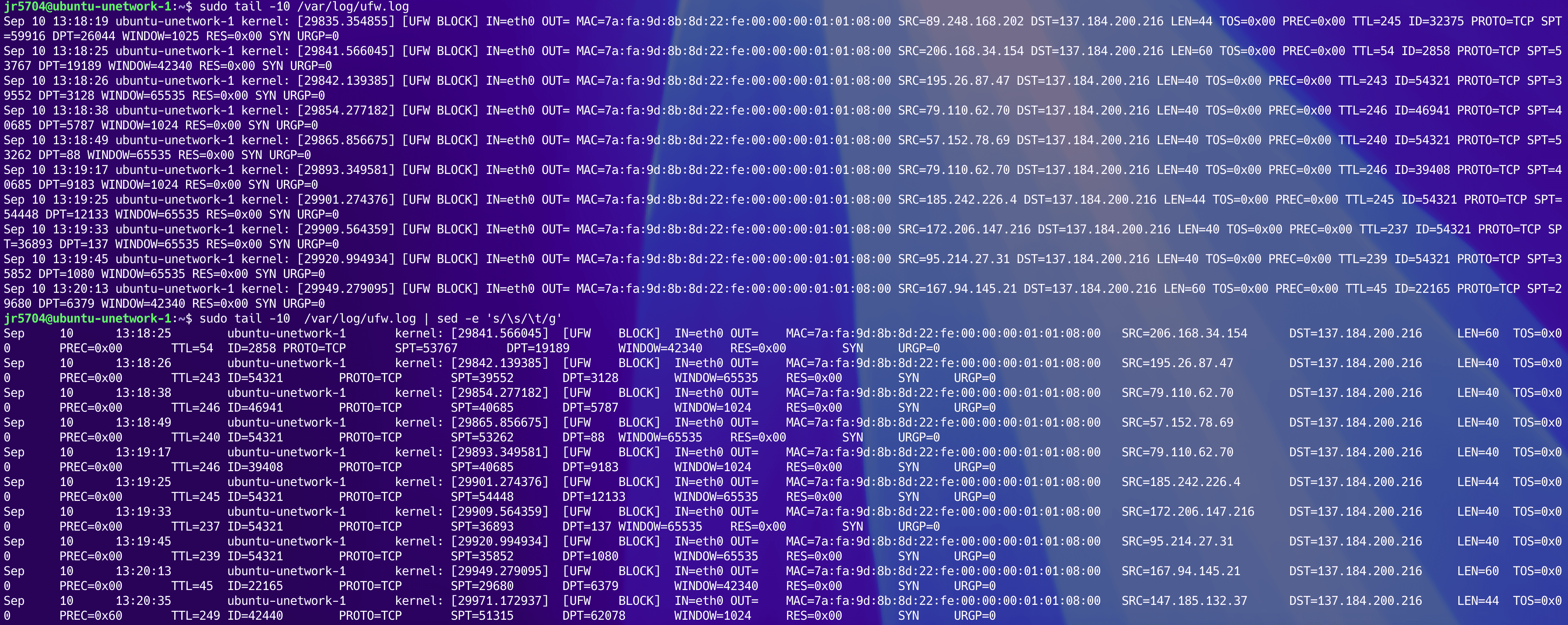
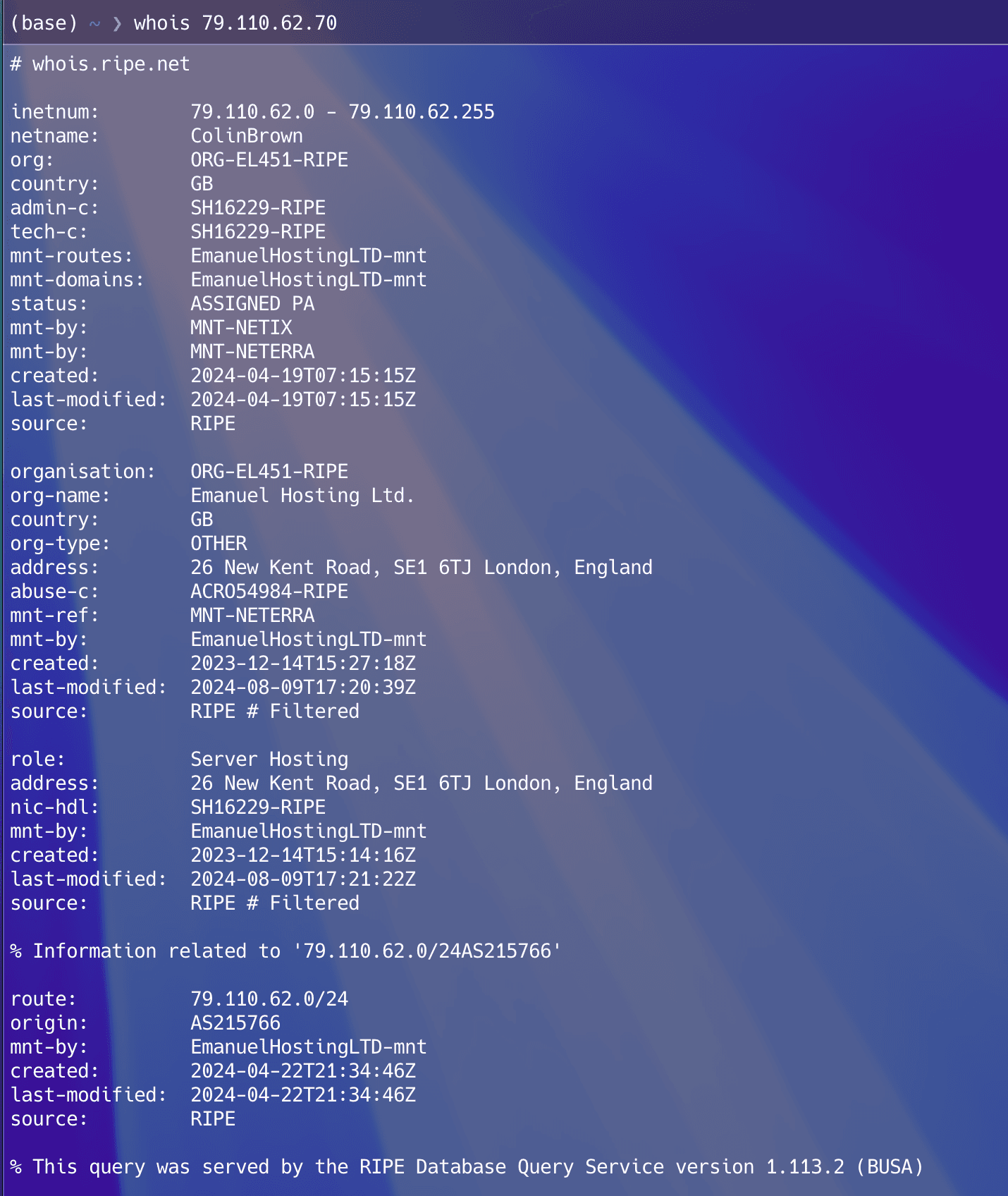
UFW netfilter packet logs on ubuntu-unetwork-1 and RIPE WHOIS / ASN attribution for top probing IPs
Anycast vs. Trans-Pacific Routing Topology (traceroute)
Running traceroute to alan.ooo (Cloudflare anycast 172.67.136.143), youtube.com, google.com, reddit.com, and torproject.org from two vantage points illustrated how BGP peering and physical submarine cable geography shape round-trip latency:
- Local Residential Fiber (Verizon FiOS, NYC/NJ
98.109.25.1): Terminates at Cloudflare and Google edge nodes within the New York metro area in 7–8 hops (6–8 ms), or traverses Hurricane Electric (he.net) from NYC (nyc4) to Dallas (dal1/dal2) in~43 msto reachtorproject.org. - Hong Kong VPN Exit (
138.199.62.204, Datacamp Limited / CDN77 HKG): Introduces a220–260 mstrans-Pacific baseline, routing across Equinix Hong Kong (15169.hkg.equinix.com), NTT Global IP Network (tokyjp10.jp.bb.gin.ntt.net), Taipei, and Manila (mnl07s01-in-f14.1e100.net).
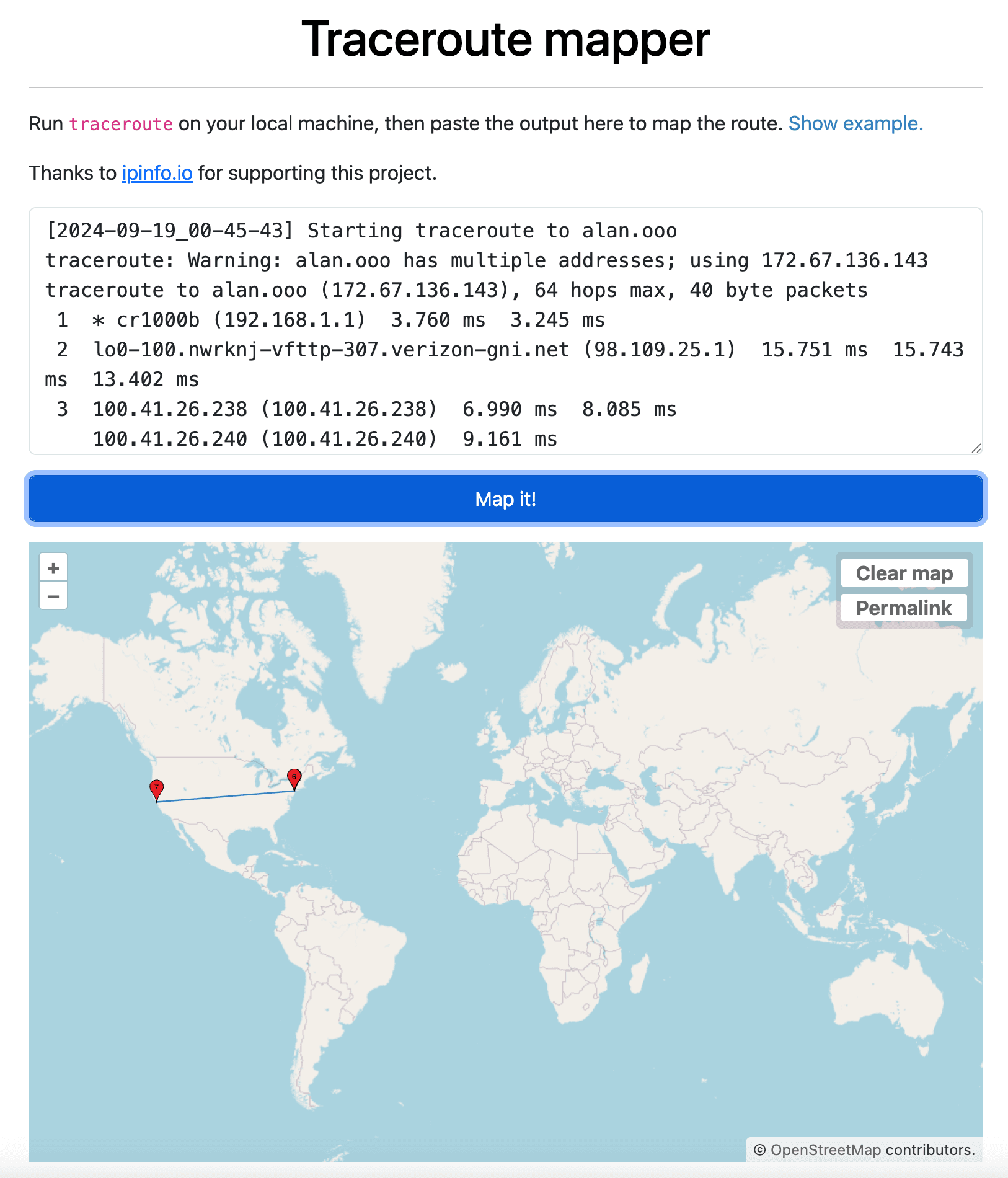
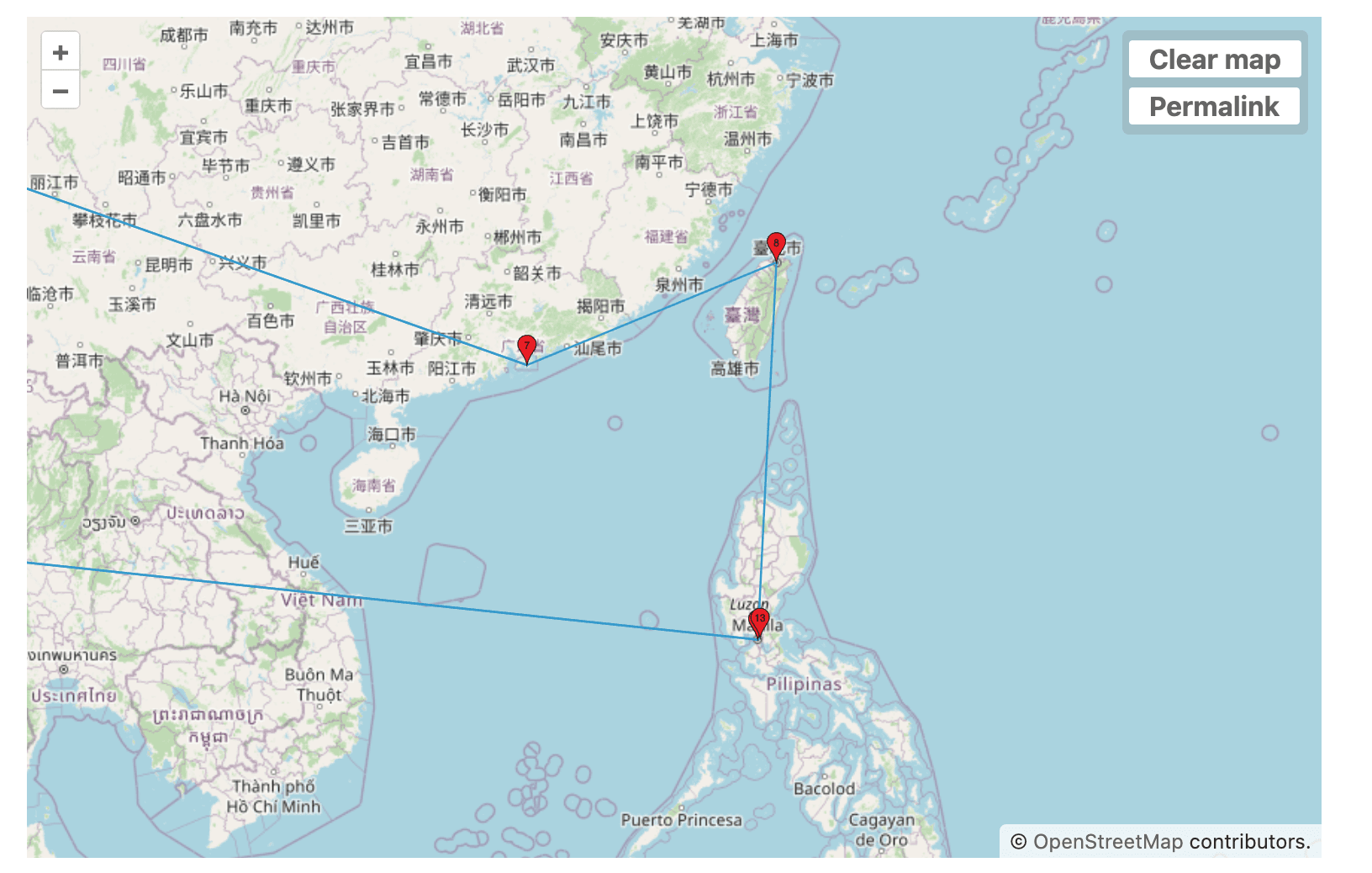
Geographic traceroute paths comparing local US metro hops against East Asia peering between Hong Kong, Tokyo, Taipei, and Manila
Web Tracking Audits & Port 53 tcpdump Inspection
The final module audited application-layer tracking with the EFF's Cover Your Tracks and The Markup's Blacklight (www.alan.ooo and ml5js.org registered 0 ad trackers and 0 third-party cookies, compared to 4 ad trackers and 5 third-party cookies on itp.nyu.edu/itp/), followed by live packet captures of port 53 DNS traffic (sudo tcpdump -i en0 -s0 port 53 vs. sudo tcpdump -i utun0 -s0 port 53). Inspecting both interfaces side by side demonstrated how plaintext UDP DNS queries on en0 expose every visited hostname (A, AAAA, CNAME, and HTTPS/Type65 records) to the local campus resolver (dns1-ha.noc.nyu.edu), and how encapsulating DNS inside Tailscale MagicDNS (100.100.100.100) and NextDNS isolates resolver visibility onto the encrypted utun0 WireGuard tunnel.
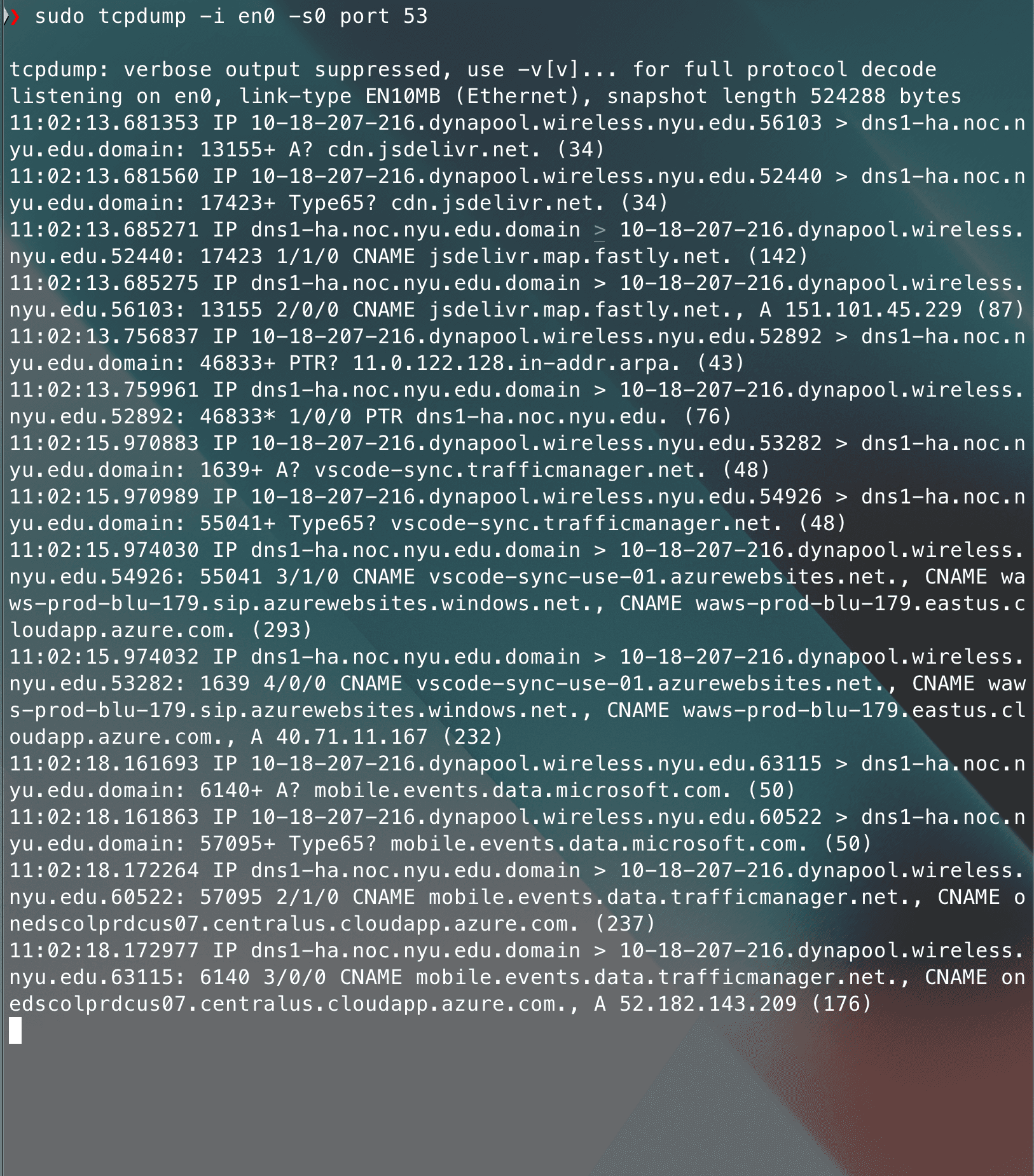
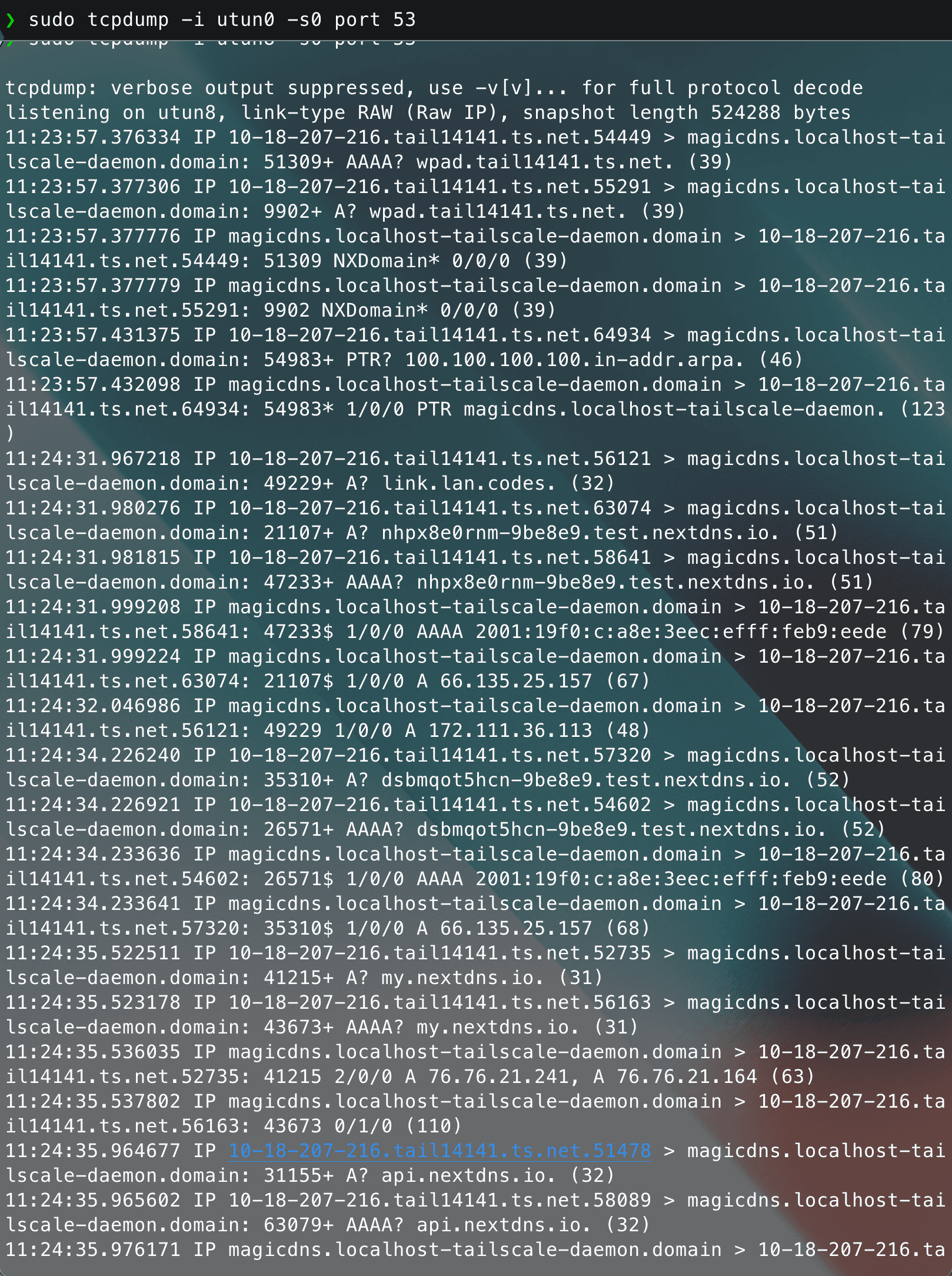
Live UDP port 53 packet captures comparing NYU campus DNS on en0 against NextDNS over Tailscale MagicDNS on utun0